Emerging Technology
Emerging Technology involves the latest innovations across various fields such as Artificial Intelligence (AI), Blockchain, Internet of Things (IoT), fifth generation wireless cellular technology (5G) and others. These technologies often develop rapidly along with new challenges, including ethical issues, security, and socio-economic impacts.
List of related articles:
National Robotics Roadmap (NRR) 2021-2030
Overview
Technology advancement in Fourth Industrial Revolution (4IR) has altered the way people live, work, and relate to one another. Emerging technologies breakthroughs such as robotics, artificial intelligence (AI), and the Internet of Things (IoT) are catalysing disruptive innovations across socio-economic sectors in the world. Robotics combined with AI and IoT are redefining the advancement and competitiveness of nations.
Due to the COVID-19 pandemic, adoption of robotics technology has been put into spotlight to accelerate automation. In most countries, robotics has become a national strategic priority. Based on the 2018 Automation Readiness Index, Singapore, South Korea, Japan, and Germany are the top 4 most prepared countries for robotics and automation. This is demonstrated by their consistent high rankings globally in the robot density measured by International Federation of Robotics (IFR). Their advancements in robotics are mainly driven by vibrant policy measures, assertive policy implementation and monitoring as well as a robust national innovation ecosystem. Strong government facilitation for innovation as well as comprehensive talent development have played a major role in enabling these countries to reach a high automation level.
Robotics is a key catalyst for Malaysia to achieve its aspiration of becoming a progressive, prosperous, and high-tech nation. Through robotics, several main challenges for Malaysia such as productivity, dependency on low-skilled foreign labour, outflow of local currency, quality of life, as well as pandemics and disasters could be addressed. Successful robotics adoption and development will help to accelerate the nation’s gross domestic product (GDP) growth. Thus, aligned with 4IR, robotics is a key technology that is vital to address these challenges and finally contribute to the socio-economic development and advancement of the nation.
The robotics journey in Malaysia started way back in early 1990s for the 1st phase (7th – 8th Malaysia Plan) with the commencement of robotics through education, research (first publication in Scopus 1992), technology adoption, and the start of a global robotics business enterprise in this country. Rapid improvement of robotics was seen during the 2nd phase (9th – 11th Malaysia Plan) with the establishment of local robotics organisations, networks, business enterprises, and policies. Then, the 3rd phase (12th Malaysia Plan and onwards) marked the aggressive efforts of Malaysia to intensify the adoption and adoption of technology under the drive of Industry 4.0 and 4IR.
There are issues, gaps and challenges that hinder the sustainable development of the local robotics industry. For example, Malaysia’s adoption of technology in the manufacturing and services sectors remain low at 37% and 20% respectively (Source: Shared Prosperity Vision 2030). Although Malaysia is ranked 36th out of 132 countries in the Global Innovation Index 2021 and 14th for the 2018 Automation Readiness Index, much still need to be done to transform Malaysia into a producer of innovative products and services, and subsequently, enable Malaysia's participation in the higher end of the global value chain.
These issues, gaps and challenges include the governance and ecosystem, talent, Research, Development, Commercialization, Innovation and Economy (RDCIE), Malaysia recognises the importance of various key players in the development and progress of robotics in the country. Therefore, the roadmap is developed through extensive consultations with key stakeholders from the government ministries and agencies, scientific community, industry, and civil society.
Objectives
The roadmap focuses on three high-impact sectors that have significantly contributed to the country’s GDP. They are the Services (Retail & Healthcare), Agriculture, and Manufacturing sectors. In the fourth quarter of 2020, these sectors (services, agriculture, and manufacturing) had contributed 57.8%, 6.8% and 23.6% of Malaysia’s GDP respectively (DOSM, 2021). For the Manufacturing sector, an increase in Malaysia's Robot Density will directly impact the nation’s productivity level. Based on a Centre for Economic Performance London School of Economics (LSE) study in 2018, it was reported that a one-unit increase in robot density translates into an approximately 0.36% increase in labour productivity. This is in parallel with the targeted annual labour productivity growth of 3.6% in the Twelfth Malaysia Plan (12th MP). While in the Agriculture sector, robotics plays a key role in precision agriculture. It supports the Malaysian government's efforts in increasing food production and supply which finally ensures food security for the nation. As for the Services sector, robotics plays a vital role during the current COVID-19 pandemic especially in ensuring the sector could resume. Furthermore, the adoption of robotics in this sector will further drive the growth momentum in the wholesale and retail trade. Successful deployment of robotics in the high-impact sectors will then bring spill over impacts to other sectors which in turn improves the value chain from laggard sectors to pace-setter sectors.
Finally, the fifth strategic thrust focuses on enhancing the socio-economic for societal well-being and quality of life. With proper implementation of the strategies, it will minimise the immediate negative social-economic impacts of the robotics adoption while building up the society's capacity to adapt. Without proper guidelines, the adoption of robotics will create fear and distrust among the community due to a mismatch of culture and traditional practices. One major area of concern will be job security where it was forecasted that around 14-18% of jobs were lost between 2016 to 2027 due to the adoption of Industry 4.0 in 5 industrial sectors (electrical & electronics, machinery & equipment, chemicals, medical device and aerospace) (Source: Draft Final Report Study on the Future of Manufacturing: "Industry 3+2" by Roland Berger). Hence, it will help in achieving a fairer and more equitable society which corresponds to the underline principals of Sustainable Development Goals (SDG) and SPV 2030.
Outcome and Impact
To identify the areas that need to be prioritised in achieving the targeted 3.5% Gross domestic expenditure on R&D (GERD) by 2030 in the National Policy on Science, Technology & Innovation (NPSTI) 2021-2030 as well as to move Malaysia’s robotics industry up the global innovation value chain, the roadmap has utilised the 10-10 MySTIE Framework as adopted in the Twelfth Malaysia Plan (EPU, 2021; ASM, 2021). Robotics converges with the Science & Technology (S&T) Drivers to serve as an enabler for all socio-economic drivers of the 10-10 MySTIE Framework. Therefore, robotics can be strategically positioned and harnessed for application in at least 26 out of 30 of the country’s STIE niche areas.
Five strategic thrusts have been developed in the NRR to address the five focus areas that had been identified and will then serve as the main pillars to ensure a dynamic advancement and adoption of robotics in Malaysia. They are accompanied by 19 strategies, 24 initiatives and 40 targets.
The first strategic thrust focuses on the development of a conducive ecosystem and governance for robotics in Malaysia. With the formation of a dedicated national coordinating body for robotics, Malaysia will be able to set, coordinate and monitor its overall national robotics agenda. Long-standing issues such as lack of strategic direction, scattered and inaccessible data, and fragmented ecosystem will be addressed to support and elevate national robotics development towards the nation’s advancement.
The second strategic thrust aims to nurture and develop industry-ready talent for robotics to ensure a robust and sustainable robotics ecosystem and development in Malaysia. This augurs well with the principle of cradle to grave education and instils the value of long-life learning effort in all fields of studies. Through this, the issues of lack of robotics talent, well-trained educators, and lack of awareness will be effectively tackled.
The third thrust focuses on bridging the gap between research and commercialisation as well as addressing the robotics adoption among users. Presently, there is still a gap in the alignment and strategic positioning of robotics R&D with the current National Research, Development, Commercialisation, Innovation & Economy (RDCIE) priority areas. This leads to low commercialisation as well as adoption and acceptance of local robotics technology. By connecting the research to businesses through the national collaborative platform for robotics, RDCIE efforts could fulfil the need of the markets and increase disruptive innovation. This finally enables Malaysia to leverage new economic opportunities for Malaysian robotics industries to enter new and emerging global markets. This at the same time will contribute to achieving the target set in accelerating RDCIE in the Twelfth Malaysia Plan specifically 70% of R&D investment to be funded by the private sector and 30% by the government as well as 50% GERD comprises experimental development research.
The fourth strategic thrust touches on the legislation where it addresses the standard, safety, and regulations’ strength to accelerate robotics innovation in a controlled, safe, and ethical manner. This will lead to a smoother integration with regional and global key players in robotics adoption. Development of proper guidelines will build up a greater confidence among the investors as the products are of high standard and quality. With recognised safety and standard guidelines, locally develop robotics products will be able to penetrate the international market. Thus, status of Malaysia as a globally recognised robotics hub supporting the vision and mission of the NRR will be elevated.
Conclusion
In conclusion, effective implementation of the strategies and initiatives through a whole-of-nation approach will create a conducive ecosystem for the country to embrace robotics technology. The direction set forth by the National Robotics Roadmap (NRR) 2021-2030 will guide and assist stakeholders in building up a vibrant and dynamic robotics ecosystem; bringing Malaysia closer towards its aspiration in becoming a progressive, prosperous, and high-tech nation. The success of the NRR will depend on the willingness of all stakeholders to embrace change and their close collaboration to systematically implement the strategic thrusts, strategies and initiatives. Steadfast commitment and support from all will ensure the realisation of the vision and mission of the roadmap.
For More Information:
Strategic Technology and S&T Applications Division
Ministry of Science, Technology and Innovation
enquiry@mosti.gov.my
03-8000 8000
Malaysia Commercialsation Year (MCY)
Malaysia Commercialisation Year (MCY) initiative has been introduced since 2016 with the aim of assisting researchers, innovators, and local entrepreneurs in accelerating the commercialisation of locally developed research and development (R&D) products, technologies, and services into both local and international markets.
Since its inception, various programs have been conducted under the MCY platform through synergistic collaborations among multiple stakeholders, including researchers, funding agencies, technology receivers, technology providers, entrepreneurs, and other relevant agencies within the commercialisation ecosystem.
Objectives of the MCY Initiative:
- To accelerate the commercialisation of research, development, and innovation (R,D&I) outcomes from universities, institutions, and local research agencies as a wealth generator.
- To increase awareness among stakeholders and the public regarding the importance and potential of innovation and commercialisation in enhancing national income.
- To provide various physical facilities and advisory services, such as incubation centres, R,D&C infrastructure, marketing assistance, and technology audits offered by various government agencies.
- To enhance the effectiveness of commercialisation efforts through synergistic collaborations among multiple stakeholders.
Key Initiatives under MCY:
- Facilitation and interventions, including due diligence sessions, pitching, coaching, and collaboration with MyIPO.
- The MCY Summit, which raises awareness of the importance of innovation and commercialisation potential.
- The MCY Awards, recognising the achievements of researchers, innovators, and local technology entrepreneurs.
- Promotion of products and technologies through expos and exhibitions to expand market reach.
Outcomes/Impact
Researchers, innovators, and technopreneurs undergo a screening process through a series of Due Diligence Workshops to assess their Technology Readiness Level (TRL). These workshops provide relevant assistance and interventions to support commercialisation efforts. As of 2023, a total of 1,285 products, technologies, and services have undergone this screening process.
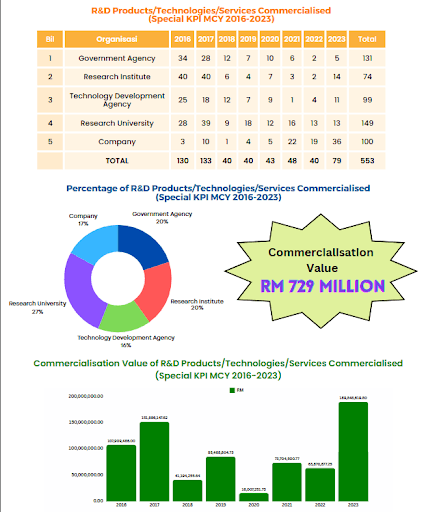
Since its implementation from 2016 to 2023, the MCY program has successfully facilitated the commercialisation of 553 R,D&I outcomes into both local and international markets, generating sales exceeding RM729 million.
MCY serves as a catalyst in transforming local research, development, and innovation into wealth-generating assets through commercialisation. The momentum of MCY’s success is further strengthened with the third wave of MCY, namely MCY 3.0 Goes Global, which runs from 2021 to 2025. MCY 3.0 focuses on expanding commercialisation networks and enhancing the competitiveness of local products, technologies, and services to penetrate global markets.
Achievements
The 8th edition of the MCY Summit 2024 was held on 12-13 August 2024 at the Kuala Lumpur Convention Centre (KLCC), attracting over 8,000 participants from both local and international communities. This year’s summit, themed "Leading the Regional Innovation," was organised in collaboration with MRANTI as a strategic partner. The annual flagship event by MOSTI aims to recognise the achievements of researchers and technology entrepreneurs who have successfully commercialised their R&D-based products, technologies, and services in local and international markets.
Key highlights of the two-day event included:
- The Opening Ceremony by YAB Dato' Seri Anwar Ibrahim, Prime Minister of Malaysia, along with the presentation of the MCY 2023 Awards worth RM1 million. The event also saw the exchange of Memorandums of Agreement (MOA) and Memorandums of Understanding (MOU) valued at over RM60 million.
- Conference sessions featuring 28 distinguished speakers from local and international backgrounds, including ministers, representatives from agencies, industries, and venture capitalists in the commercialisation ecosystem. Among the key topics covered are Hydrogen Economy, Artificial Intelligence (AI), and startups.
- An exhibition showcasing 98 local R&D-based products, technologies, and services.
- Six satellite sessions organised by MOSTI agencies and other government agencies focusing on commercialisation.
- Thirteen podcast sessions discussing key topics in innovation, technology, and commercialisation with invited guests.
Further Information
For further inquiries, please contact:
Ms. Halema binti Shajahan
Technology Transfer & R&D Commercialisation Division
Ministry of Science, Technology, and Innovation (MOSTI)
Tel: 03-8885 8389
Email: halema@mosti.gov.my
National Technology and Innovation Sandbox (NTIS)
The National Technology and Innovation Sandbox (NTIS) was launched in 2020 to create a conducive environment for technology and innovation to thrive in Malaysia. It provides a platform for entrepreneurs, researchers, innovators and companies to test, validate and transform ideas into successful businesses through the sandbox approach. NTIS is a crucial initiative that has already driven impactful solutions across industries.
From its inception in July 2020 to January 2025, NTIS has received 868 applications, approving 124 projects for funding. A total of RM120.4 million has been allocated to foster the development of innovative solutions. These efforts have resulted in 70 technologies reaching commercialisation, generating RM145.8 million in sales.
Innovation sandboxes are more than just regulatory tools; they are enablers of economic growth, drivers of technological progress and catalysts for societal transformation. Globally, sandbox initiatives have unlocked breakthroughs in critical industries such as financial technology, renewable energy, healthcare and artificial intelligence.
As Malaysia navigates the challenges and opportunities of the Fourth Industrial Revolution, NTIS serves not only as a roadmap for adaptation but also as a gateway to leadership in innovation. By fostering safe yet dynamic environments for experimentation, sandboxes empower regulators, industry players and innovators to collaborate and bring transformative ideas to life.
To date, NTIS, in collaboration with strategic partners, has established 15 national sandbox sites across various sectors, including Agriculture, Robotics & Automation, High-Tech Education, Sustainable Smart Cities and Artificial Intelligence (AI). These sandboxes demonstrate that innovation thrives in the right environment, allowing groundbreaking ideas to be tested, refined and brought to market.
Further Information
For further inquiries, please contact:
Mr. Rizal Azwir
Malaysian Research Accelerator for Technology & Innovation (MRANTI).
Email: a.rizal@mranti.my
Website: https://sandbox.gov.my/
