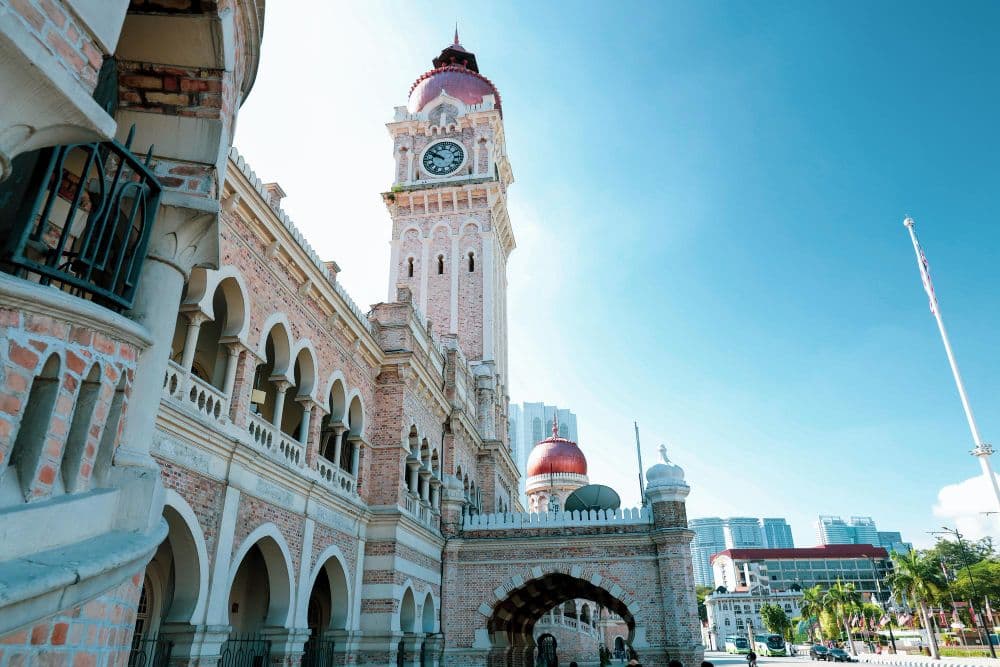
Malaysian History

The Era of the Malay Sultanate of Malacca around 1400 AD
In its heyday, the sultanate's territory covered most of the Peninsula and the East Coast of Sumatra. Melaka emerged as a glorious kingdom because of its authoritative leaders, efficient administrative and government systems, as well as its strategic position at the meeting point between East Asia and West Asia. This situation allowed Malacca to emerge as a major trading center, especially for the spice trade in Southeast Asia. Islam emerged as the main religion that spread and became the main faith of the Malacca population because its king himself had embraced the religion.
Colonial Era
In 1511, Malacca fell to the Portuguese and from this year onwards, Malaya entered the colonial era. After that, Malaya fell to the Dutch in 1641 and finally fell to the British in 1824 through the Anglo-Dutch Treaty. The British intervened in all the administrative affairs of Malaya which were previously managed by the Malay Kings with the help of state officials. This British intervention caused dissatisfaction among the local population. Several individuals rose up against the colonialists, including in several states such as Dol Said, Tok Janggut, Datuk Bahaman, Rentap, Datuk Maharajalela, Rosli Dhoby and several other figures.
The Rise of Nationalism
In the 1920s and 1930s, most of the nationalism, political awareness and national development of the people of Malaya began to receive education, whether from the Middle East or locally. As a result, an educated group emerged who began to champion the spirit of nationalism. They used print media such as newspapers, magazines, short stories and novels to spread their respective ideologies. Some of them formed associations such as the Kesatuan Melayu Singapura (KMS) and Kesatuan Melayu Muda (KMM) which aimed to expel the colonialists and form their own government. The advance of Japanese troops into Malaya from 8 December 1941 to 15 February 1942 marked the beginning of another era of colonialism in Malaya. However, the Japanese who occupied Malaya until 1945 surrendered following the atomic bombing of Hiroshima and Nagasaki.
Japanese Occupation Withdrawal and Establishment of the Malayan Union
The Japanese withdrawal gave way to the Malayan Communist Party (MCP) to take control of Malaya. The MCP launched an attack to take control of Malaya by force, killing three European rubber plantation managers in Sungai Siput, Perak. As a result, in June 1948, Sir Edward Gent declared a state of emergency throughout Malaya. The MCP failed to conquer Malaya and the British returned to power. The British Military Administration (BMA) was between the end of World War II and the establishment of the Malayan Union. On 1 April 1946, the British established the Malayan Union. However, this idea was opposed by the Malays because of the abolition of the royal institution and the privileges of the Malays.
Declaration of Independence
Tunku Abdul Rahman Putra Al-Haj had raised the spirit of the struggle of the people of Malaya at that time when his action of forming the Alliance Party in 1952 began to open the eyes of the British to allow the people of Malaya to govern their own country. The unity between the three main races, namely the Malays, Chinese and Indians, had shown results when the London Agreement signed on 8 February 1956 gave a sign that the Federation of Malaya would be independent on 31 August 1957. Upon Tunku Abdul Rahman Putra Al-Haj's return from London, Tunku made a declaration of independence for the Federation of Malaya at Padang Bandar Hilir, Melaka on 20 February 1956.
Establishment of Malaysia
On 27 May 1961, Tunku Abdul Rahman Putra Al-Haj proposed the merger of five colonies, namely the Federation of Malaya, Singapore, Sabah, Sarawak and Brunei, to form a new country. On 9 July 1963, representatives of the British government, the Federation of Malaya, Sabah, Sarawak and Singapore, except for Brunei due to unavoidable circumstances, agreed to join forces. The desire to form a country called Malaysia was achieved on 16 September 1963.
Updated date: 10/17/2025
