


State Government
The State Government's administrative structure focuses on domestic affairs such as land, Islam and local government.
State policies are implemented by state departments and agencies, while the state civil service manages the implementation of policies and public services at the district and local levels.
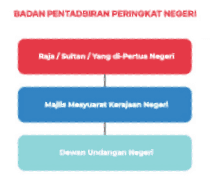
Rulers and Governors
Heads of state and symbols of sovereignty.
- Monarchical states: Johor, Kedah, Kelantan, Pahang, Perak, Selangor, Terengganu
- Non-monarchical states: Melaka, Pulau Pinang, Sabah, Sarawak (headed by the Yang di-Pertua Negeri appointed by the YDPA)
State Executive Council (EXCO)
- Highest executive authority of the state
- Headed by the Menteri Besar (monarchical states) or Chief Minister (non-monarchical states)
- EXCO members are appointed from among the State Legislative Assembly members and are responsible for various state government portfolios
State Legislative Assembly (DUN)
- Passes state laws
- Consists of members elected through elections
- Must obtain the consent of the Raja/Sultan/Yang di-Pertua Negeri
State Government Administration Machinery
- States are divided into several districts, mukim or divisions (especially in Sabah & Sarawak)
- Led by District Officers or Residents
- Officers are appointed by the State Public Service Commission (SPN) or the Malaysian Public Service
State Departments
Divided into:
- State departments that are branches of federal agencies
- State-specific departments under state authority
Responsible for implementing state policies in various fields
State Commissions
- Supervise appointments and the state civil service
- States without a state commission (such as Melaka, Pulau Pinang, Sabah, Sarawak) use the Federal Public Service Commission
State Civil Service
- Covers administrative and technical posts
- Some posts (such as PTD and PTA) are seconded from the Federation to the state
State Secretary & Financial Offices (Sabah & Sarawak)
- Coordinate all state departments and federal agencies
- The roles of the Federal Secretary and Federal Financial Officer are important in state administration
State Statutory Bodies
- Companies fully owned by the state government or its subsidiaries
- Act as corporate entities that contribute to economic development and services
Updated date: 10/2/2025
Comment this section